Disclosure: This article contains referral links. If you buy through them, we may earn a small commission at no extra cost to you.
Hyperpigmentation is the most common skin concern in Pakistan — the dark spots, uneven tone, and melasma that come from our sun, pollution, acne, and hormones. If you are searching for hyperpigmentation treatment in Pakistan, this guide covers what it actually is, the treatment pathways that work, when a dermatologist is needed, and how to build a routine around it.
What hyperpigmentation actually is
Hyperpigmentation is excess melanin deposited in patches — the dark spots and uneven tone that result. The main types Pakistani skin deals with:
- Post-inflammatory hyperpigmentation (PIH) — the marks acne and irritation leave behind; the most common type.
- Sun-induced pigmentation — sun spots and uneven tone from UV exposure; Pakistan’s high UV index makes this nearly universal.
- Melasma — the symmetrical hormonal patches on cheeks and forehead; triggered by hormones, pregnancy, and sun exposure combined.
The treatment pathways that work
- Topical actives — the first-line treatment: melanin inhibitors (kojic acid, alpha arbutin), transfer blockers (niacinamide), and turnover accelerants (glycolic acid, retinol). These are the foundation — effective, accessible, and safe for most people.
- Sunscreen — the non-negotiable: every treatment fails without daily SPF; UV is what produces the pigment, so without protection the spots keep forming faster than treatments fade them.
- Chemical peels — dermatologist-administered peels for persistent cases that topicals cannot reach; a real option at Pakistani clinics.
- Prescription treatment — hydroquinone and prescription retinoids for stubborn cases, only under a dermatologist — never self-prescribed.
The products that treat it — available in Pakistan
- For PIH and everyday spots: the Trego Skin Lightening Serum pairs niacinamide with alpha arbutin — around Rs.1,499.
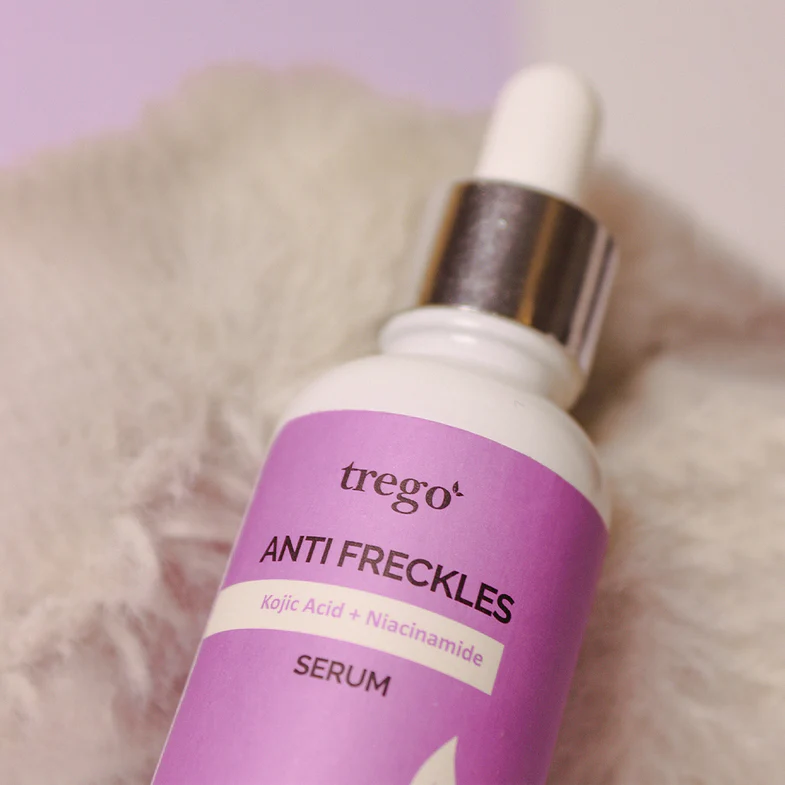
- For melasma and stubborn pigmentation: the Anti-Freckles Serum leads with kojic acid — around Rs.1,449.
- For faster turnover: the AHA brightening toner at 5% glycolic speeds the shedding.
- For protection: the SPF 50++ sunscreen — the step that makes everything else work.
When to see a dermatologist instead
See a dermatologist when pigmentation is widespread, spreading, accompanied by other symptoms, or has not responded to consistent topical treatment after 3 months — persistent melasma and hormonal-driven pigmentation especially benefit from clinical care.
The routine that works in Pakistan
- Morning: gentle cleanse → pigment serum → moisturizer → SPF 50++ — the protection step that keeps the others working.
- Night: gentle cleanse → pigment serum → moisturizer.
- 2–3 nights weekly: glycolic toner for faster turnover — not on retinol nights.
- Consistency rule: expect visible improvement within 4–8 weeks; hyperpigmentation clears gradually as pigmented cells shed.
Get 5% off with code Expo5
Order through Export Shelf — it sends you to the official Trego checkout — and enter Expo5 for 5% off your order. We have tested this code on our own orders and it worked every time, including on sale days. See our trego discount code guide for the walkthrough.
Frequently asked questions
What is the best hyperpigmentation treatment in Pakistan?
For most people, topical actives — niacinamide, alpha arbutin, kojic acid — plus daily sunscreen is the first-line treatment. Stubborn cases benefit from chemical peels or prescription care at a dermatologist.
How long does hyperpigmentation treatment take?
Topical treatments show visible improvement within 4–8 weeks of consistent use; deeper pigmentation takes months and may need clinical care.
Does melasma respond to treatment?
Melasma responds to melanin inhibitors like kojic acid combined with strict sunscreen — but it is hormonal, so it can recur without ongoing protection.
Can hyperpigmentation be removed permanently?
It can be faded significantly, but new spots form under UV and hormonal triggers — consistent treatment and sunscreen keep it managed rather than cured once.
Is treatment different for Pakistani skin?
The actives work the same, but higher UV exposure and different hormonal factors mean sunscreen is even more critical in Pakistan’s climate.
Referral note: we may earn a commission when you buy through the links in this guide. It does not change your price — and the Expo5 code takes a further 5% off.